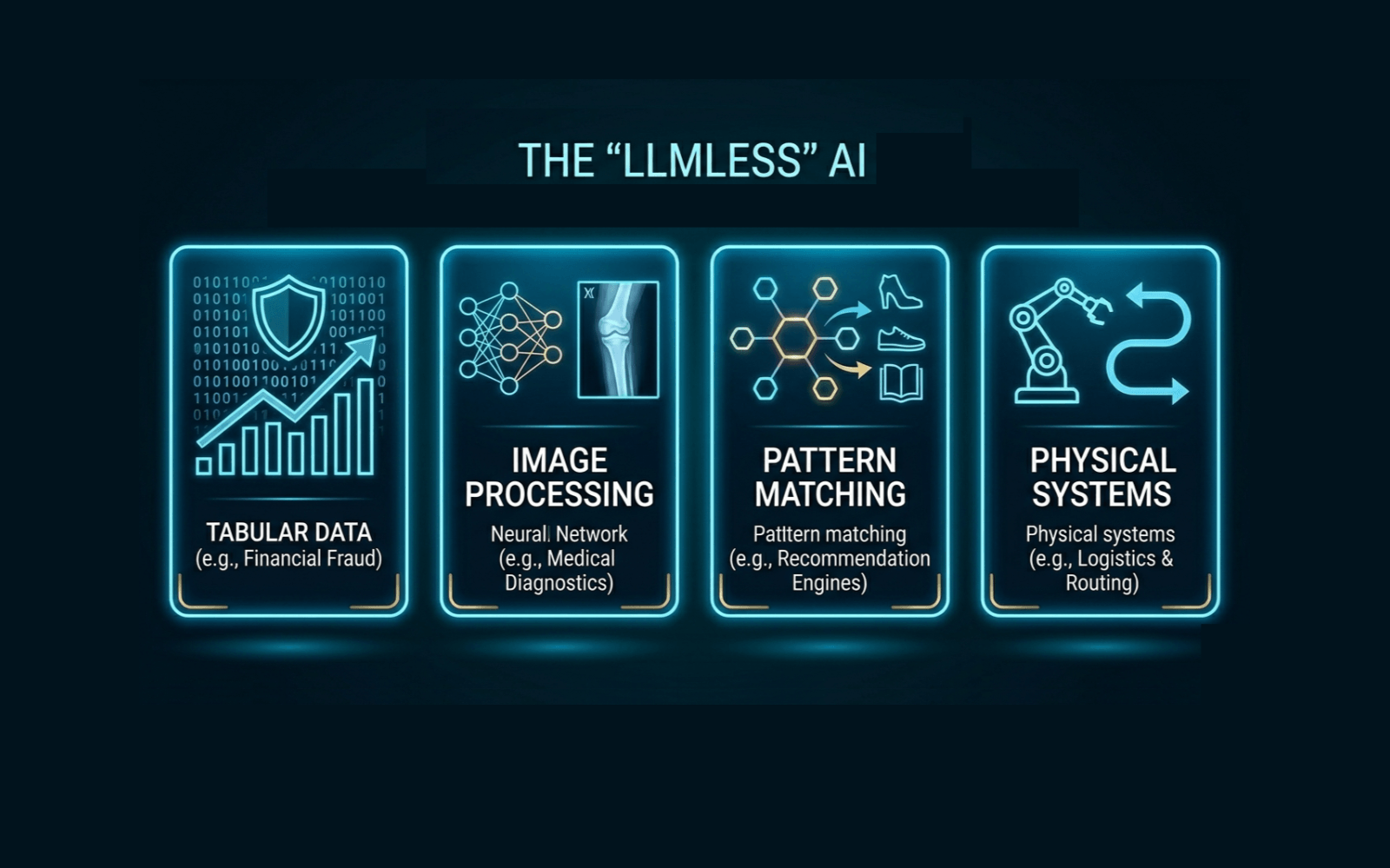
Our collective approach to AI has developed a quiet blind spot. As Large Language Models (LLMs) have dominated the narrative, "AI" and "LLM" have become almost synonymous. In the rush to adopt generative tech, the more varied and efficient toolkit available to us has been largely ignored.
LLMs are remarkable at handling unstructured text and synthesizing information, but they are probabilistic and resource-heavy. When a problem involves structured data, microsecond latency, or mathematical precision, an LLM is often the most expensive and least effective tool for the job.
The "LLMless" ecosystem consists of models trained for specific modalities—numbers, pixels, or coordinates. They aren't "lesser" tools; they are the right ones.
When specialized models do it better
Financial Fraud — Random Forests & XGBoost Detecting credit card fraud requires processing tabular data (amount, location, time) in milliseconds. A Random Forest or Gradient Boosted Tree can analyze these numerical features with extreme precision and low cost. Using an LLM to "reason" through a transaction table is not only too slow for a checkout line, but it’s prone to hallucinating patterns that don't exist.
Medical Diagnostics — Convolutional Neural Networks (CNNs) A model identifying a tumor in an X-ray isn't reading a story; it’s identifying spatial patterns in pixels. CNNs are purpose-built for visual data. While multimodal LLMs can describe an image, they lack the specialized spatial understanding and clinical auditability required for high-stakes medical decisions.
Retail & E-commerce — Matrix Factorization The most effective recommendation engines don't use LLMs to tell you what to buy. They use Matrix Factorization to find mathematical patterns in user behavior across millions of data points. An LLM might know that "people like sci-fi," but a specialized engine knows exactly which items have overlapping tastes based on hard interaction data.
Logistics — Reinforcement Learning (RL) Optimizing the route for thousands of delivery trucks is an optimization problem with physical constraints like traffic and fuel. RL agents learn through millions of simulations to find the most efficient path. This is a logic and physics task that language models were never designed to solve.
How to mix and match for better results
This isn't about replacing LLMs; it’s about using them where they actually shine. In many systems, an LLM acts as the interface, translating a user’s messy natural language into a clear, actionable command. That command is then routed to a specialized "engine"—like a Random Forest for calculations or a CNN for image analysis—that can handle the heavy lifting with mathematical precision.
However, this linguistic layer is optional; many high-performance pipelines skip the LLM entirely, feeding structured data directly into specialized models. Whether an LLM is used to synthesize the final output or not, the core principle remains: the architecture follows the data, using each model for what it does best rather than forcing one model to do everything.
LLMs are not the universal answer. Neither is avoiding them. The engineers who understand both — and know when to use which — are the ones building systems that actually hold up in production.